TierarztTalk: Darkness
Dogs in the Dark: Their Vision and Perception at Night
In the current issue of TierarztTalk, our pet hero Dr. med. vet. Julia Rettberg dedicates herself to the topic of darkness and answers exciting questions about our beloved four-legged friends. As a senior veterinarian at MeikoVet Small Animal Practice in St. Gallen, she shares her extensive knowledge and provides insights into the world of dogs at night.
Can dogs see in absolute darkness?
In absolute darkness, even dogs cannot see anything. The sensory cells of the retina require at least faint light reflections, such as from moonlight.
Why do dogs see better than humans in twilight?
The retina of a dog’s eye has a different composition of rods (sensory cells for black-and-white vision) and cones (for color vision) than that of humans. This is due to evolutionary adaptations. For example, the wolf, as the ancestor of the dog, needed the ability to spot its prey even in twilight, while Stone Age humans, as hunters and gatherers, benefited from color vision to determine the ripeness of fruits, for instance. Additionally, the area in the back of the dog’s eye, known as the “tapetum lucidum,” reflects incoming light, thereby enhancing sensory perception. This is why dogs often have green eyes in photos.
“That dogs only see in black and white
is a myth.”
Dr. med. vet. Julia Rettberg, Head Veterinarian
Are there other animals that see better in low light?
Nocturnal hunters, such as owls and cats, but also prey animals like rabbits, see much better in low light than humans.
What colors do dogs see?
Dogs can perceive the shorter wavelengths of the color spectrum from violet through blue and green to yellow. They have a particularly high number of receptors for blue and yellow light. However, they cannot distinguish between shades that appear orange to red to us, as the retinal receptors are not receptive to the longer wavelengths. The idea that dogs only see in black and white is a myth.
How far can dogs see?
Dogs can see a similar distance to humans. While visual acuity is not routinely tested in domesticated dogs, as it is not vital for their survival, just like with us, there are also myopic individuals among dogs. For example, studies have been conducted on German Shepherds that were retired from service because they did not perform well in protection work. In these dogs, the eyes were examined, and myopia was diagnosed.
Are flashing lights unpleasant for dogs?
Flashing light, especially in different colors, can irritate dogs, as, for example, shadows in the surroundings appear differently, and the dog cannot rely on its eyes. A very relaxed dog will probably have fewer problems with this than a rather anxious and timid dog.
How does a dog perceive a night walk?
Dogs are “nose animals.” Scents are much more important to dogs than visual stimuli. In the dark, it is usually cooler and more humid. During the day, especially in heat, odor-carrying particles rise with the warm air and are blown away by the wind. The ability to filter and perceive odor particles from the air depends on the number of particles present in the air. Therefore, dogs even enjoy roaming around in twilight and sniffing their surroundings.
If the dog does not gain enough information through its eyes or nose, it concentrates on its hearing. Therefore, it reacts more strongly to sounds like cracking or rustling than during the day.
Are dogs afraid of the dark?
Dogs generally are not afraid of the dark. Nevertheless, more anxious and insecure dogs may react more strongly to stimuli in the dark, as they are on heightened alert when they see less. They may also react to shadowy figures that approach silently without announcing themselves with sounds, such as a broad-shouldered man with a hood and dark rain jacket or a large umbrella.
How do I know if my dog is scared?
If a dog trusts its handler, it will look to them for guidance when it is scared. A dog, on the other hand, that believes it needs to protect its owner, is more likely to rush forward and bark at a perceived danger it is afraid of.
“Dogs are nose animals.
Scents are much more important to dogs than visual stimuli.”
Dr. med. vet. Julia Rettberg, Head Veterinarian
What diseases can impair vision in the dark?
All opacities of the otherwise transparent parts of the eye (cornea, aqueous humor, lens, vitreous body) impair vision not only at night but also during the day. Causes can include: cataracts (lens opacity), inflammation, or bleeding in the inner eye. The fewer light stimuli reach the retina, the worse the dog can see.
Are there natural remedies for the eyes?
Vitamin A is still considered natural “food” for the sensory cells. However, it should not be supplemented if the dog already receives enough through its diet. In cats, an overdose of Vitamin A (e.g., from exclusive liver feeding) can even lead to pathological ossification of the spine.
How can eye diseases be prevented?
Prevention, as in all areas of health, is important for early detection of diseases. This includes being informed about which breeds are susceptible to certain diseases. German Shepherds can develop chronic keratitis, which is promoted by UV radiation. If this is detected early and treated consistently, the dog can live well with it. Affected dogs can be protected from harmful UV radiation with sunglasses.
In Jack Russell Terriers, however, lens luxation (detachment from the suspensory apparatus and displacement into the anterior chamber or vitreous body) and resulting glaucoma can occur. Early detection and correct treatment are very important here, as the increased pressure in the eye is extremely painful and can even cost the dog its sight.
Labradors can go blind in middle age due to a progressive decrease in retinal sensory cells (atrophy). Genetic tests are now available for the early detection of progressive retinal atrophy (PRA).
Darkness poses accident risks. Are accidents in the dark a common problem for dogs visiting your practice?
It happens repeatedly that an injured animal comes to the practice in the evening. If a dog breaks free from its leash in the dark and runs onto the road, the risk of an accident is much higher than in daylight, as the driver may not notice the dog or notice it too late. The same applies in the forest if the dog, for example, chases a cat or a rabbit and steps into a hollow or gets caught on barbed wire that it would have seen during the day.
What should be considered from a medical perspective when walking a dog in the dark?
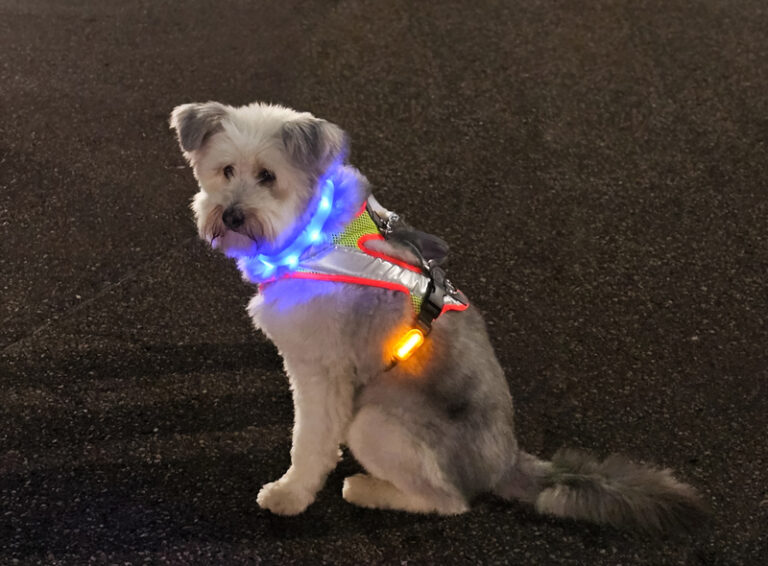
Ensure that you and your dog are clearly visible to road users with bicycles and cars, as well as to oncoming pedestrians. It is advisable to choose a leash with reflective elements in addition to a luminous collar or harness. This avoids unwanted tripping hazards. For insecure dogs that are irritated by luminous and flashing objects, reflective items can be used as an alternative. In the stores of Meiko Heimtierbedarf AG, you will find a select range of high-quality luminous items that help you and your four-legged friend be optimally visible in the dark.
More exciting facts?
Many owners already know that cataracts in dogs can now be surgically removed. However, not many know that there are even artificial lenses for dogs that can be implanted into the eye to replace the removed lens.
Author:
Dr. med. vet. Julia Rettberg
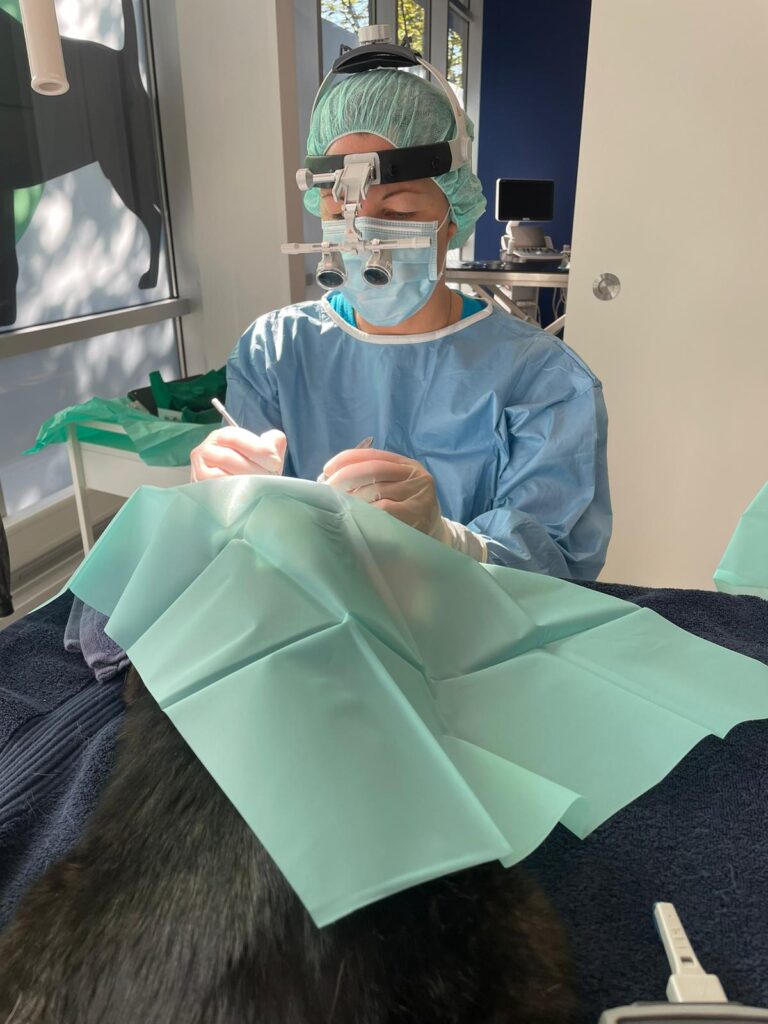
Dr. med. vet. Julia Rettberg is the head veterinarian at MeikoVet in St. Gallen and an accredited veterinary ophthalmologist. She received the General Practitioner Certificate in Ophthalmology from the International School of Veterinary Postgraduate Studies (ISVPS).
Author:
Dr. med. vet. Julia Rettberg
Dr. med. vet. Julia Rettberg is the head veterinarian at MeikoVet in St. Gallen and an accredited veterinary ophthalmologist. She received the General Practitioner Certificate in Ophthalmology from the International School of Veterinary Postgraduate Studies (ISVPS).